
Everything behind the list.
My Day is what people open. This is what keeps it honest — the jobs, the timelines, the crews, the service calls and the reports that make the ranking mean something.
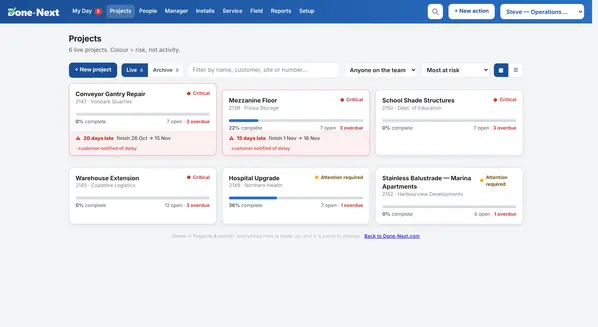
Every job on one page, coloured by risk.
Not by activity, not by how recently someone touched it — by whether it is actually going to land on time.
- Percent complete, open work, and what is overdue, per job.
- A plain-English risk line: “20 days late · finish 15 Sept → 5 Oct”.
- Whether the customer has been told yet — and a task raised if they haven't.
- Archive, not delete, so last year's work still answers questions.
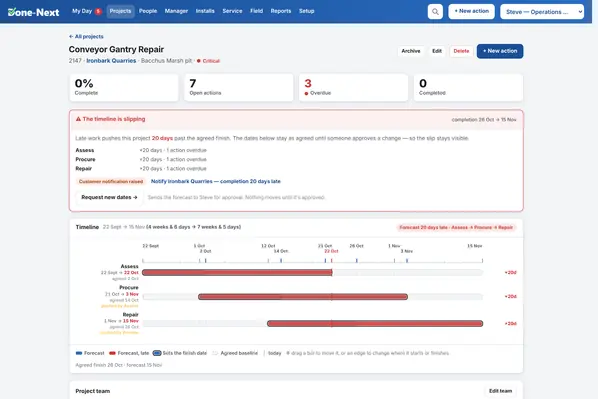
A timeline that forecasts, not one you redraw.
Stages are linked the way the work really runs — and an overlap you typed in is a deliberate head start, while a gap is slack the plan absorbs on its own.
- Slip travels only to what genuinely waits on it. Everything else stays put.
- The chain driving the finish date is named, so you know what to chase.
- Drag a bar to move it, or an edge to make it longer — same as the board.
- Dragging never changes an agreed date on the spot. It opens the change for approval, with a reason, because that date was promised to somebody.
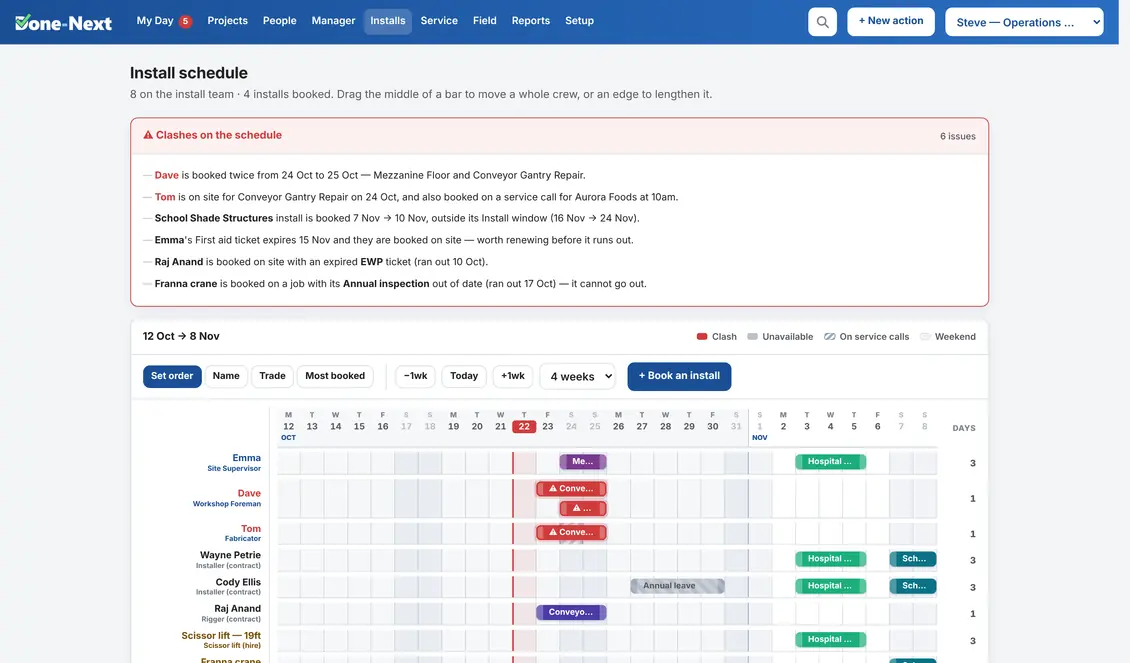
Who is where, this fortnight.
Crews, contractors, vans and plant on one board. Drag a booking to move it, drag an edge to make it longer, and the board tells you the moment two jobs want the same person.
Clash detection
Two jobs, one rigger, same Tuesday. You find out while you are still holding the mouse.
Leave is a first-class thing
Annual leave, RDOs and sick days block the day properly, instead of living in a separate calendar nobody checks.
Tickets and licences
EWP, working at heights, white card, plant inspections — tracked with expiry dates, and flagged before you book someone who can't legally be there.
Callouts and planned work, on the same board.
Reactive jobs, scheduled servicing and work that runs under an agreement — all in one day view, with the technician, the window and the site.
- Agreements that raise their own recurring visits, on time, without a reminder.
- A completion record per visit: what was done, what parts went on, what's outstanding.
- Unassigned work made obvious, rather than sitting in a queue nobody owns.
- Service history per site, so the third callout to the same door is visible as one.
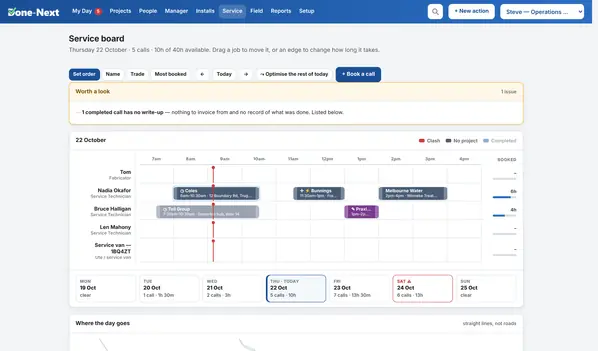
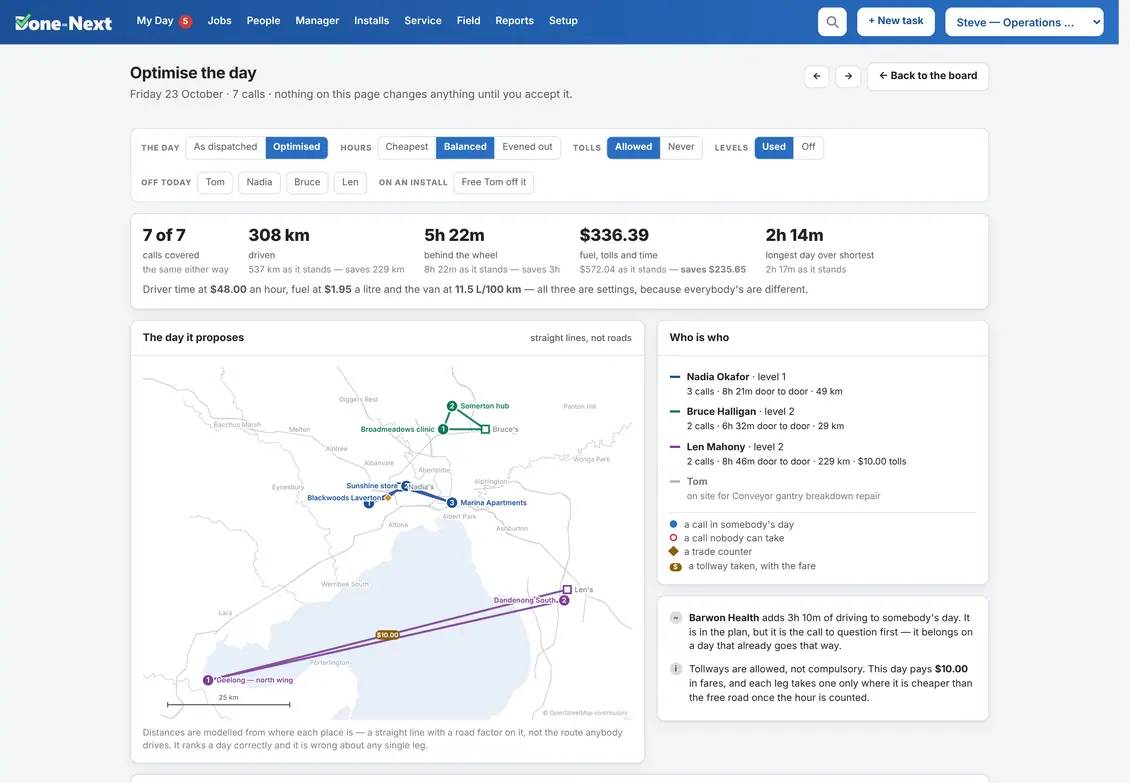
It will cost the day and reorder it — and ask first.
One button on the day board. It knows what a kilometre in your vans costs and what an hour of labour costs, so the answer comes back in dollars rather than as pins on a map.
- A page of its own: a map of the day, the hours lane by lane, what moves and why, and accept all or just the ticked ones.
- Every technician is sent as far as you say from their own home — so a company across three states plans one state at a time without setting anything up, and a call nobody is near is flagged rather than quietly handed to somebody 1,400 km away.
- A site's own hours are respected and never negotiated with — wards open nine till three, induction after lunch — which is different from an hour somebody promised, and the board does not confuse the two.
- What-if switches: take somebody off the day, or free them off an install, and watch it re-plan. Nothing is written while they are on.
- A promised time is never moved — not earlier, not later — and a call already under way is left where it is.
- Whichever day is on the board, so tomorrow can be set up this afternoon.
- Skill levels and customer priority respected: nobody is sent somewhere they are not signed off for.
- A dial between the cheapest day and an even one, with the price of fairness on screen before you buy it.
- When nobody can take a call it says which of the reasons it is — and names the people standing there who are not allowed near it.
The trade counter is a stop on the run.
Most callouts that need a part need a different supplier each time, so there is nothing to set up: type what to collect and where, on the call.
Driven to, not noted
Its own leg, its own quarter of an hour at the counter, and its own wait if the doors don't open until seven — all of it in the day's figures.
Collected where it costs least
The pickup slides to the cheapest point in that technician's day instead of sending the van back across town at two o'clock. Never after the call that needs it.
By the person doing the call
If the plan hands the job to somebody else, the part goes with it. Nobody ever collects a part for a job they are not going to.
No supplier register
The places you have used before come back as a list, built from the work itself. There is nothing to maintain.
In the van, in order
What to collect, where from, the hour it opens and a map link — in the run on the phone, between the calls either side of it.
And when it is the part's fault
A call that would have fitted perfectly well without the pickup says so, instead of blaming a level or a diary.
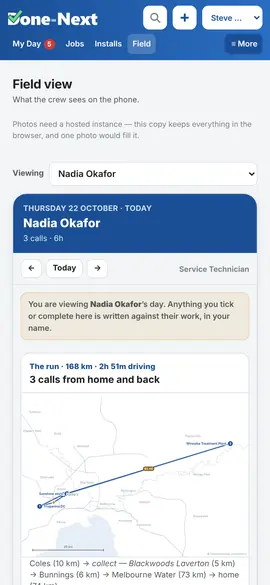
For the people who aren't at a desk.
The same system, on a phone, showing only today. No app store, no separate login to reset, no training.
- Today's run in order, with addresses that open in maps.
- Tick it off, add a photo, write what happened — thirty seconds in the van, from whichever card is in front of them.
- Their own tasks appear beside their bookings, so nothing lives in two places.
- Works on the worst phone on the crew, because it is just a web page.
It comes to you, before you open anything.
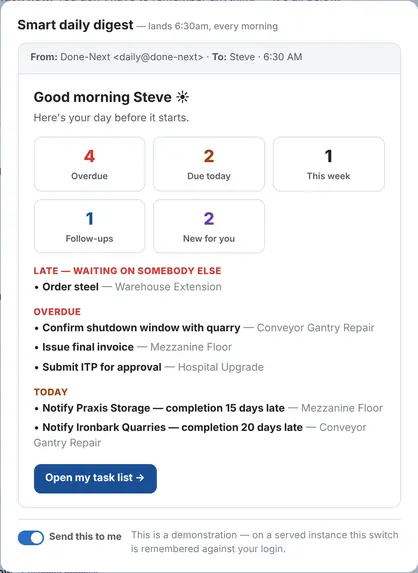
One email at half past six. Overdue first, then what is due, then what somebody owes you — the same list as My Day, arriving in an inbox that is already open.
- Everybody gets their own. Nobody is sent a list of other people's work.
- A quiet morning sends nothing at all, so it never becomes another email to filter.
- Weekends off unless you say otherwise, and anyone can switch theirs off without asking an administrator.
- Preview exactly what will land before you turn it on for the team — no guessing what your people will receive.
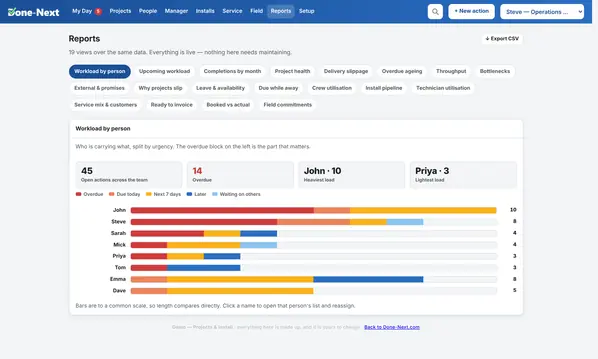
Nineteen reports, none of which need building.
Where the work is, where the time went, what is late and why, which customers are costing you and which crews are actually free next month.
- Pick from a list, read it, export it. No report designer, no query builder.
- Every figure on screen ties back to the work underneath it.
- What you are allowed to see follows the org chart, the same as everywhere else.
The parts you configure, and the parts you never touch.
| You set | What it changes |
|---|---|
| Your people | Who exists, who reports to whom, and who can approve a date change. This is the only compulsory setup. |
| Your words | What the system calls a job, a customer, a task and a stage. Every screen, report and email follows within the second. |
| Roles on a job | Job Runner, Estimating, Purchasing, Site Foreman — name them how your business does. Templates assign work to the role, so the same template produces different owners on different jobs. |
| Templates | A kind of job you do often, with its stages and its whole task list already in it. New job, pick the template, done. |
| Ticket types | The licences and inspections your industry actually cares about. |
| Who can change what | Administrators own the people list. Beyond that you can let one named person keep the field staff, customers, sites and templates up to date — without handing them everybody's access. Removing somebody stays with an administrator. |
| Nothing else | There is no workflow designer, no custom field editor and no automation builder. Those are the features that turn software into a second job. |
It can run with no customer section at all.
Sooner or later somebody's IT department asks what you hold about them. Switch this on and the honest answer is nothing — because there is nowhere to put it.
- A job becomes a name and a number. The number is already how you tie it back to your own quote and your own invoice, so the system never needed to know who the work was for.
- No customer records, no contacts, no site addresses — not hidden, not coded, not there.
- The service board switches off with it, because a service call is somebody else's site by definition. A module that can't do its job should be off, not hollowed out.
- Nothing else changes. Timelines, forecasting, approvals, the crew board, My Day and the reports that don't depend on customers all carry on exactly as they were.
The fastest way to judge it is to use it.
Five demos, each set up for a different kind of business, with a realistic week already in them. No sign-up, no email, no trial clock.