
For service and maintenance
Half your week is booked and half of it arrives by phone. The trick is the planned work still happening when the callouts land.
Three things that go wrong, and always for the same reason.
Nobody could see it in time.
The planned service slips because a callout came in
It gets pushed to next week, then the week after, then it is a year later and the agreement says quarterly.
Three visits to the same door in a month
Different technicians, no shared history, and nobody spots that it is the same fault coming back.
The paperwork comes back on Friday, if at all
What was done, what parts went on, what is still outstanding — reconstructed from memory, days later, by someone who has been to nine other sites since.
Set up the way you actually work.
- Agreements raise their own visits. Quarterly means quarterly, whether or not anyone remembered — and an unassigned visit is visible, not lost in a queue.
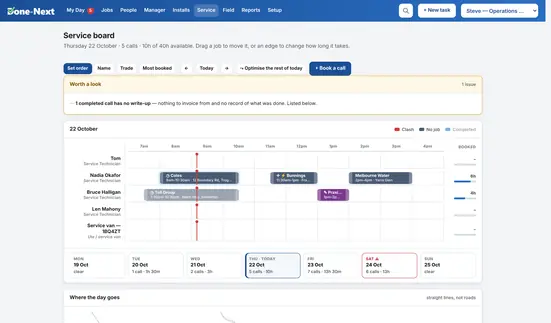
- Callouts and planned work on one day board, so you can see what has to give before you promise a two-hour response.
- A completion record per visit, filled in on the phone in the van: what was done, parts fitted, what's outstanding.
- Service history per site. The third visit to the same roller door shows up as a pattern instead of three unrelated jobs.
- One button that costs the day and puts it in order, without ever moving a time you promised somebody. It shows you what it would change before anything changes.
- Parts collected on the way, from whichever counter it is this week, by the technician who is doing the call.
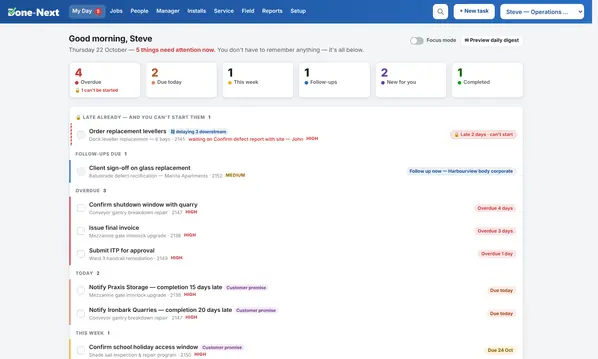
One button that puts the day in the cheapest order it can find.
It knows what a kilometre in your vans costs and what an hour of labour costs, so what it proposes is in dollars, not in pins on a map.
It proposes. You decide.
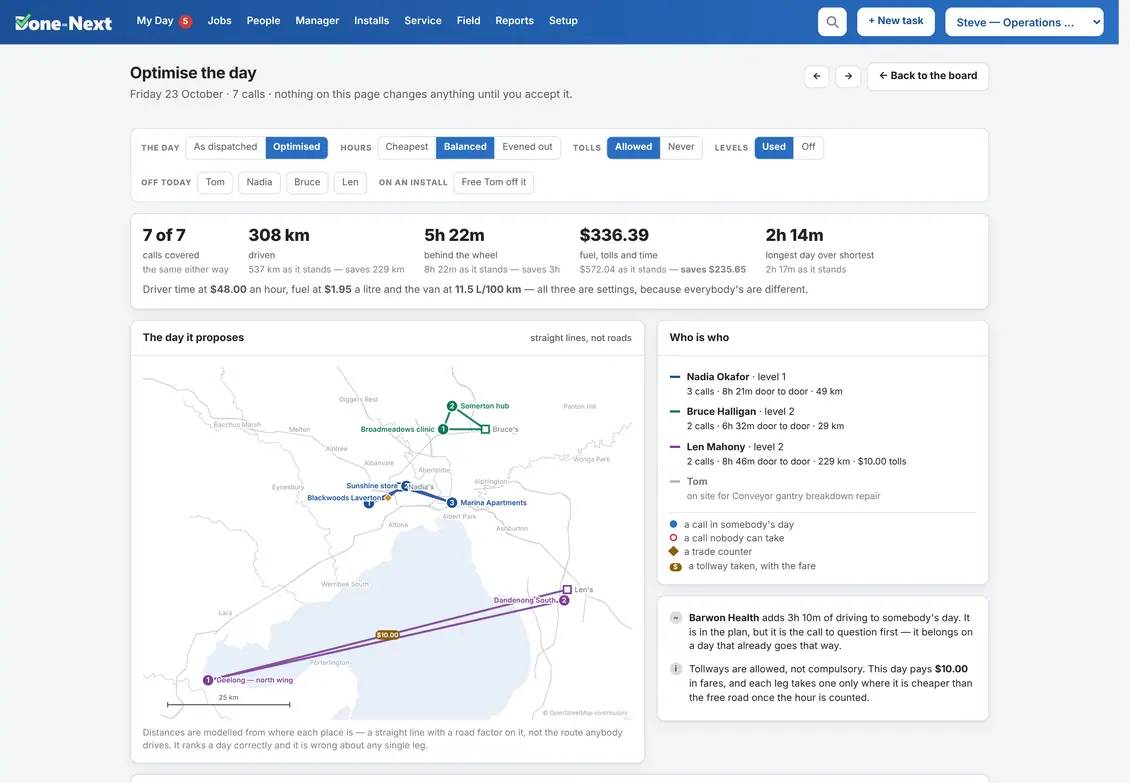
Press Optimise and a page of its own opens with the day it would run: a map, the hours, what moves and why. Nothing changes until you accept it — and you can accept half of it, tick by tick, which is what actually gets used.
A promised time is never moved
Not earlier, which is a van at a gate before anyone expects one, and not later. A call already under way is left alone. Everything else is fair game.
Tomorrow, at four o'clock today
It optimises whichever day is on the board, not just today — which is when a dispatcher actually does it.
Only people who are allowed to go
Sites can need a skill level and customers can outrank each other. Nobody is sent somewhere they are not signed off for, however much room their day has.
An even day, if you want one
One dial between cheapest-possible and share-it-out. Move it and watch the longest and shortest day close up — so you can see what fairness costs before you buy it.
And when nobody can go, it says why
Too long for the day; the site shuts first; no room without arriving late somewhere promised; the part, not the people; a level nobody holds; or nobody within reach — named, with the nearest technician and the distance.
Every move has a reason you can read
Not "the day will not take it", which is true of everything that ever moved. For each call the day is rebuilt with that one forced back onto whoever had it, and what broke is the reason: keeping it with Nadia means Barwon Health finishes 4:41pm, site closes 3:00pm.
Three states, one board
Each technician is sent as far as you say from their own home — 300 km unless you change it, or give one person their own figure. A call nobody is within reach of is flagged with the nearest technician named, and a Perth day never gets mixed into a Melbourne one's figures.
What if he rings in sick?
Switches on the bar take somebody off the day, or free them off an install, and re-plan it in front of you. Nothing is written while they are on — it says so — and putting them back restores the day.
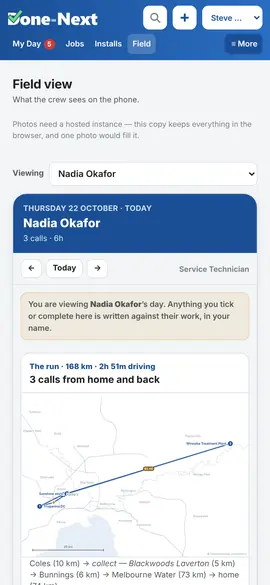
The trade counter is a stop on the run, not a note in the job.
Most callouts that need a part need a different supplier each time, so there is nothing to set up. Type what to collect and where, on the call.
- It is driven to. Its own leg, its own quarter of an hour at the counter, and its own wait if the doors don't open until seven.
- Collected where it costs least. The pickup slides to the cheapest point in that technician's day — first thing, on the way past — rather than sending the van back across town at two o'clock. Never after the call that needs it.
- Whoever collects it is whoever does the call. If the plan hands the job to somebody else, the part goes with it.
- The places you have used before come back as a list, built from the work itself. Nobody maintains a supplier register.
- And it is on the phone in the van: what to collect, where from, the hour it opens, and a map link — in the run, in order.
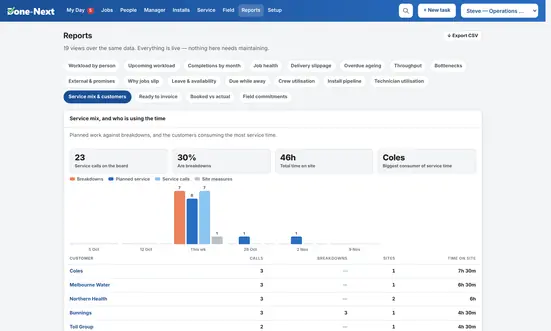
Real screens, from the demo you can open.
Not mockups. Every image on this page is a screenshot of the same demo linked at the top, taken automatically when the site was built.
Not quite you?
Then pick the nearest and change the words, or start from none of them. The software is identical in every case — these are starting points, not categories you have to belong to.
Have a look at your own week in it.
The Service & maintenance demo has a realistic fortnight already loaded — overdue work, a job running late, a crew double-booked. Click anything.